The Goose and the Mink
Summary
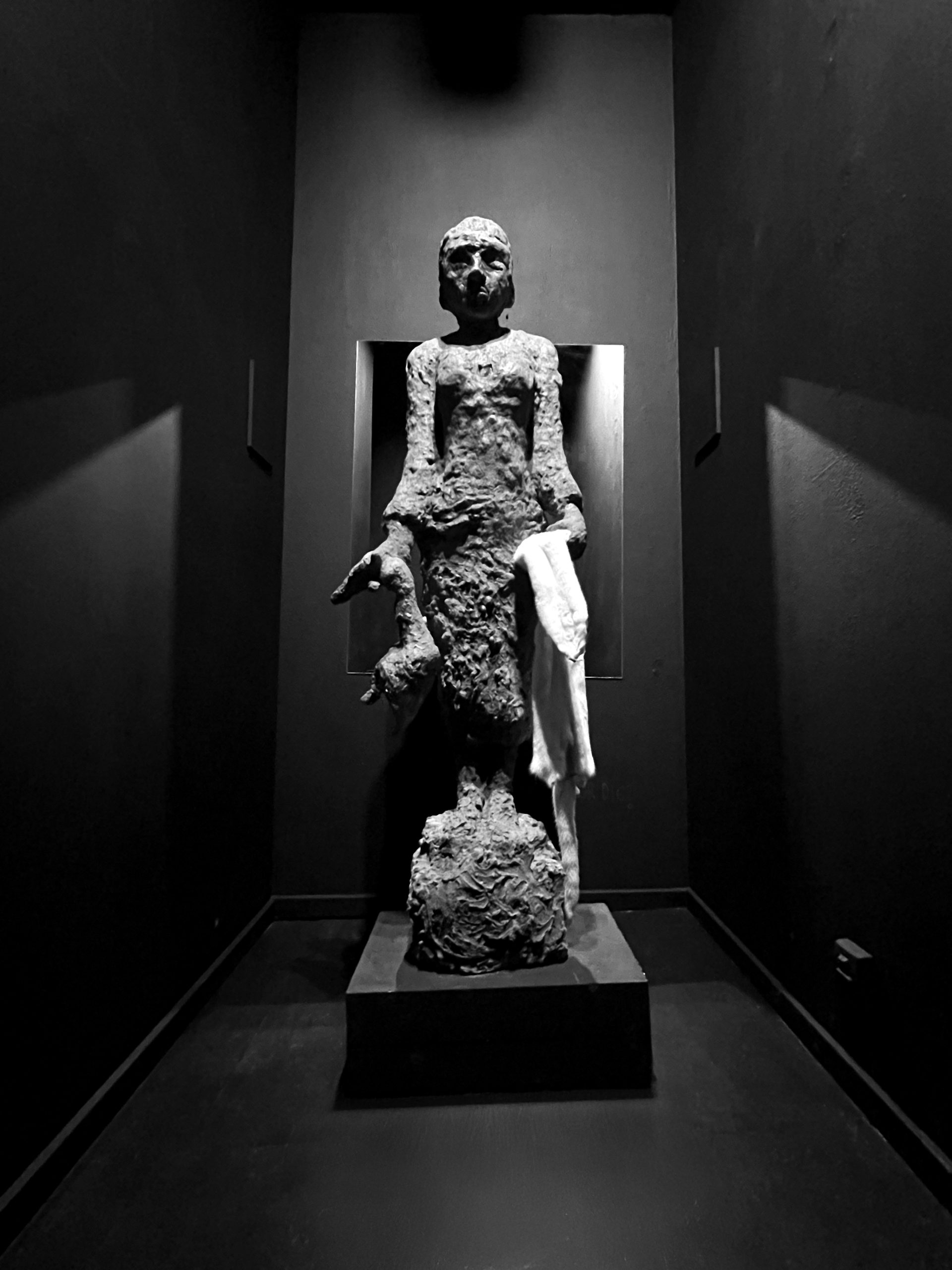
“The Goose and the Mink” is a 180 cm tall concrete sculpture by Louise Stubberup. The figure of a woman holds a goose in one hand and a mink fur in the other, with a small mirror placed where the heart should be. At its core lies a carved wooden Buddha, symbolizing peace and reflection.
The work combines Danish history, tradition, and fairy tales. The mink fur comes from the first animal killed against the free will of the mink farmer during COID-19, while the goose refers to the tale The Goose Girl, where truth and dignity win the day.
The sculpture invites viewers to pause and reflect on their own choices and values. By looking into the mirror at its heart, we are reminded to ask ourselves which virtues truly guide our lives.
Extended artwork description
by Katie Jørgensen, writer, experience writing for museums and art galleries in New York City
”The Goose and the Mink” (Danish: “Gåsen og Minken”) is a concrete sculpture of the everywoman. She must move forward and live her life not always knowing the consequences. This is sculpture of a person of Danish identity who is balancing reality and dream to hopefully dare to live life with purpose and poise.
”The Goose and the Mink” identifies the conscience of a Danish individual. It is, of course, alive and well. But, we all must make decisions – this statue evokes the overall question: how do we live ethically as a Dane? What virtues form the foundation of our life choices? Who the hell are we?
A mink is an animal who anthropomorphizes the idea of tradition specifically in Danish culture. In terms of how raising minks has been long valued trade in Denmark, but at the same time, it exists today as strong a symbol of a recent clash in Danish opinions. It is also a symbol of drastic decisions to uphold one’s belief. There is a dichotomy embodying the mink.
A Dane identifies somehow in this clash one way or another, because Danish tradition manifests it.
Honoring one’s identity in Danish individual’s subconscious is not so simple. In Danish society, and people overall in the modern world, are constantly changing their perspectives.
Tradition and beliefs stem from stories that are shared for centuries. The goose in the tale “The Goose Girl” symbolizes the epitome of valuing truth and dignity above all else. The individual must gage personal beliefs on many levels when making decisions both big and small. As honor in one’s word is paramount in Danish culture, one can see the same level of integrity from geese who saves the day by speaking the truth when the goose girl could not.
The Goose and the Mink” is a concrete sculpture built upon another statue of spiritual significance, a carved wooden Buddhist monk. The core of the statue is a symbol of ultimate peace, but the Buddha can also embody the quest for authenticity and offers space for reflection, as one strives to live with integrity.
The Story Behind ”The Goose and the Mink”
”The Goose and the Mink” is based on a significant piece of Danish history: the fur from the first mink that was killed against the free will of the mink farmer during the COVID-19 pandemic. The intervention was a turning point that ended a traditional Danish export industry and put an end to an era in which mink fur was a global commodity. The fur was acquired by Louise Stubberup on the same day that “Børsen” – one of Denmark´s iconic heritage buildings and home of the Danish Confederation of Industry – was in flames, which for the artist linked several layers of symbolism to the story.
The connection to the fairy tale “The Goose Girl” arose when the iconic sculpture in Aalborg with the same motif was undergoing restoration. The fairy tale’s timeless message of choosing one’s virtues – instead of simply going with the flow – became the artistic key that unlocked the work’s final form.
”The Goose and the Mink” is a 180 cm tall sculpture made of raw concrete, shaped like a female figure with an inner core of wood carved like a Buddha figure. In one hand she carries a goose, cast in concrete, and in the other a mink fur – from the first mink to be killed against the free will. Instead of a heart, there is a small glass-covered room with a mirror and blood from the Danish mink farmer whose herd was the first to be killed against the free will during the shutdown of mink production in Denmark. On the back is engraved: “We should be proud, but not satisfied” (Danish: “Vi skal være stolte, men ikke tilfredse”)
The work invites the viewer to stop in a busy everyday life and reflect on life’s choices and values. The mirror in the heart allows the viewer to see themselves at the center of the work – literally and symbolically – and confronts us with the question of which virtues we base our life choices on – and whether these are truly the ones we wish to live by!
The Artist Louise Stubberup
Louise Stubberup is a Danish contemporary artist who works at the intersection of raw urbanity, the human inner life and pop cultural references. She creates monumental concrete sculptures and powerful paintings, often with an uncompromising materiality and direct symbolism. From STUBBERUP GALLERY in Aalborg, she challenges conventional forms of presentation and gives space to artists who work with authenticity and edge.